
Both passages use the Greek phrase glōssais lalein ('to speak in tongues/languages'), yet describe sharply different settings. In Acts 2:4–11, Spirit-filled Galileans speak unlearned foreign languages (dialektō) immediately recognized by Parthian, Egyptian, and Roman pilgrims—reversing Babel. In 1 Corinthians 14:2, speakers address God rather than people ('no one understands him; he utters mysteries') unless someone interprets, prompting Paul's strict church-order rules.
Acts 2 at Pentecost: fifteen native birth-languages reversing Babel
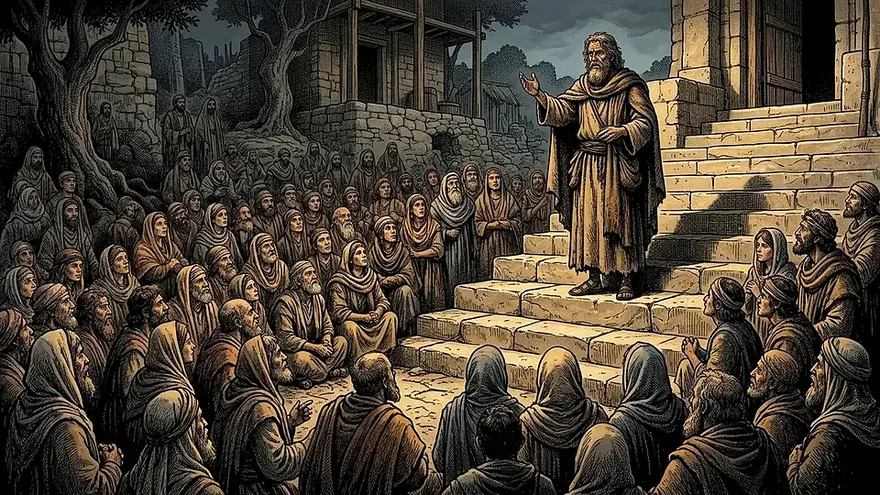
Fifty days after Passover, Jewish pilgrims from Persia to Rome packed Jerusalem for Shavuot (Pentecost). When rushing wind and flames fill the disciples' room in Acts 2:4, Luke says they spoke in 'other tongues' (heterais glōssais)—and verses 6 and 8 immediately clarify what the street crowd heard.
Amazed visitors ask: 'How is it that we hear, each of us in his own native language (tē idia dialektō)?' Galilean fishermen were declaring God's mighty works in recognizable Parthian, Median, Egyptian, Arabic, and Latin (xenolalia)—reversing Genesis 11's fractured speech at Babel without erasing national languages.
Acts 2:4, 6, 8“And they were all filled with the Holy Spirit and began to speak in other tongues (heterais glōssais)... each one was hearing them speak in his own language (tē idia dialektō)... 'How is it that we hear, each of us in his own native language?'”
Why It Matters: 1611 KJV translators inserted the italicized word 'unknown' six times across 1 Corinthians 14 where Paul wrote bare glōssē ('tongue'), sharpening the real contrast with Acts 2:6–8 where Luke specifies dialektos—recognizable foreign languages understood immediately without an interpreter!
Scrolls & Archaeology: Paul's striking phrase in 1 Corinthians 13:1 ('the tongues of men and of angels') illuminates 1 Corinthians 14's unintelligible prayer-speech via Second Temple Jewish mysticism: in the 1st-century BCE/CE Testament of Job (chapters 48–50), Job's daughters put on shimmering celestial cords and stop speaking human vernacular to chant hymns in 'the dialect of the Archons' and 'the dialect of the Cherubim' (tē dialektō tōn cheroubim). Likewise, Qumran's Songs of the Sabbath Sacrifice (4Q400–4Q407) describes celestial princes praising God in 'wondrous tongues' inside the heavenly sanctuary.

Inside Corinth's house church: 'For no one understands him' (1 Corinthians 14:2)
Jump twenty-five years west to Greek Corinth in 1 Corinthians 12–14 and the scene flips! Status-conscious Corinthians were speaking untranslated tongues simultaneously during worship, leaving neighbors unhelped. Read Paul's opening line in 1 Corinthians 14:2: 'One who speaks in a tongue speaks not to men but to God; for no one understands him (oudeis gar akouei), but he utters mysteries in the Spirit.'
In Jerusalem, tongues addressed foreign crowds with zero interpreter required; in Corinth, tongues rise upward to God while the speaker's analytical mind (nous) stays unfruitful (14:14) unless someone exercises the gift of interpretation (hermēneia, 14:27).
1 Corinthians 14:2, 14“1 Corinthians 14:2 — 'For one who speaks in a tongue speaks not to men but to God; for no one understands him, but he utters mysteries in the Spirit.' · 1 Corinthians 14:14 — 'For if I pray in a tongue, my spirit prays but my mind (nous) is unfruitful.'”
Unlearned human languages vs. 'tongues of angels' (1 Corinthians 13:1 & Testament of Job)
Why do Luke and Paul sound so different while using the same Greek noun glōssa? Scholars divide into two main views. View One holds every New Testament instance was an unlearned human language—instantly recognized in polyglot Jerusalem, yet baffling inside monolingual Greek Corinth until translated.
View Two links 1 Corinthians 14:2 ('speaks to God') with 1 Corinthians 13:1 ('the tongues of men and of angels'), Romans 8:26, and Second Temple texts like the first-century Testament of Job (chapters 48–50), where Job's daughters don heavenly sashes and chant hymns in the angelic dialect of the Cherubim!
1 Corinthians 13:1“If I speak in the tongues of men and of angels (tais glōssais tōn anthrōpōn lalō kai tōn angelōn), but have not love, I am a noisy gong or a clanging cymbal.”

Paul's guardrails: five clear words beat ten thousand untranslated syllables
Pagan cults around Corinth and Delphi prized wild frenzy (mania) devoid of self-control. Paul draws a firm boundary in 1 Corinthians 14:23, 32–33: 'The spirits of prophets are subject to prophets!' If an outsider walks into thirty people shouting untranslated tongues at once, 'will they not say that you are out of your minds (mainesthe)?'
Paul never bans tongues—writing 'do not forbid speaking in tongues' (14:39)—yet enforces strict church order: at most two or three speakers, one at a time, ONLY if someone interprets; otherwise stay silent in church and pray privately to God (14:27–28).
1 Corinthians 14:18–19, 27–28“I thank God that I speak in tongues more than all of you. Nevertheless, in church I would rather speak five words with my mind in order to instruct others, than ten thousand words in a tongue... If any speak in a tongue, let there be only two or at most three, and each in turn, and let someone interpret.”
Acts 2 (Jerusalem Pentecost) vs. 1 Corinthians 14 (Corinthian Assembly)
Side-by-side Greek text comparison of the two flagship New Testament passages on tongues.
| Dimension | Acts 2:4–11 (Pentecost) | 1 Corinthians 12–14 (Corinth) |
|---|---|---|
| Greek Terms Used | Heterais glōssais = idia dialektō ('own native dialect') | Glōssē lalein; 'tongues of men and of angels' (13:1) |
| Primary Direction | Proclaiming God's mighty deeds to international crowds | Speaking prayer & thanksgiving upward to God (14:2, 16) |
| Need for Interpreter? | None—pilgrims immediately hear their own birth-languages | Mandatory in church—otherwise 'no one understands' (14:2, 28) |
| Effect on Unbelievers | Crowds gather amazed & 3,000 believe after Peter's sermon | Untranslated chaos makes outsiders say 'You are mad!' (14:23) |
| Apostolic Rule | Once-for-all redemptive milestone echoed in Acts 10 & 19 | Max 2–3 in turn with interpretation; else private prayer only |
What to Remember
- Acts 2:6–11 equates Pentecost's 'other tongues' (heterais glōssais) directly with real birth-dialects (dialektō) across fifteen Mediterranean and eastern regions, turning Babel's scattered speech upside down.
- In 1 Corinthians 14:2, 14, Paul describes Spirit-directed prayer speech addressed to God that neither the congregation nor the speaker's own analytical mind (nous) decodes without the companion gift of interpretation.
- Paul steers a disciplined middle course in 1 Corinthians 14:27–39: never forbid tongues, cap public turns at two or three with mandatory interpretation, and prioritize clear prophecy that builds up everyone.