

Hebrew 1 Samuel 28:7 never calls the woman of Endor a 'witch'—she is an ’eshet ba‘alat-’ov (אֵשֶׁת בַּעֲלַת־אוֹב, 'mistress of a ritual ancestor-pit'). Tellingly, she screams at the top of her lungs when Samuel appears before she casts a single spell, proving her occult craft didn't command him; most modern scholars read Samuel's appearance as an extraordinary judgment sent by God.
Zero broomsticks or cauldrons: What 'ba‘alat-’ov' meant in ancient Canaan
Forget Shakespearean cauldrons—the English word 'witch' never appears in the text of 1 Samuel 28 (it entered popular speech from 16th-century Bible chapter headings during King James VI/I's witchcraft trials). In Hebrew verse 7, disguised King Saul sneaks past Philistine lines at night to consult an ’eshet ba‘alat-’ov (אֵשֶׁת בַּעֲלַת־אוֹב) at Endor.
Cognate with Hittite a-a-bi and Mesopotamian ab, an ’ov was a small ritual pit dug into an earthen floor where Canaanite mediums poured blood or wine libations to coax ancestral shades up from the underworld—a practice Isaiah 8:19 mocks for 'chirping and muttering' from the dust.
1 Samuel 28:7 & Isaiah 8:19“1 Sam 28:7 — 'Seek out for me a woman who is a medium (ba‘alat-’ov).' · Isa 8:19 — 'Consult the mediums and the necromancers who chirp and mutter!'”
Why It Matters: King James I had personally authored Daemonologie (1597) warning against English witches and their 'familiar spirits,' shaping 1611 KJV's vocabulary and chapter header where Hebrew describes a Canaanite necromancer operating an earth libation pit ('ov).
Scrolls & Archaeology: Comparative Hittite and Ugaritic ritual texts illuminate Hebrew 'ov via cognate āpi—a shallow pit dug into the soil and drenched with blood or wine to lure underworld shades upward, whereas Alexandrian Septuagint translators rendered ba'alat-'ov as engastrimythos ('belly-talker / ventriloquist'). Notice also verse 13's striking use of 'elohim for the deceased prophet Samuel's rising shade, proving Biblical Hebrew used 'elohim for any inhabitant of the disembodied spiritual realm rather than exclusively for the Creator.
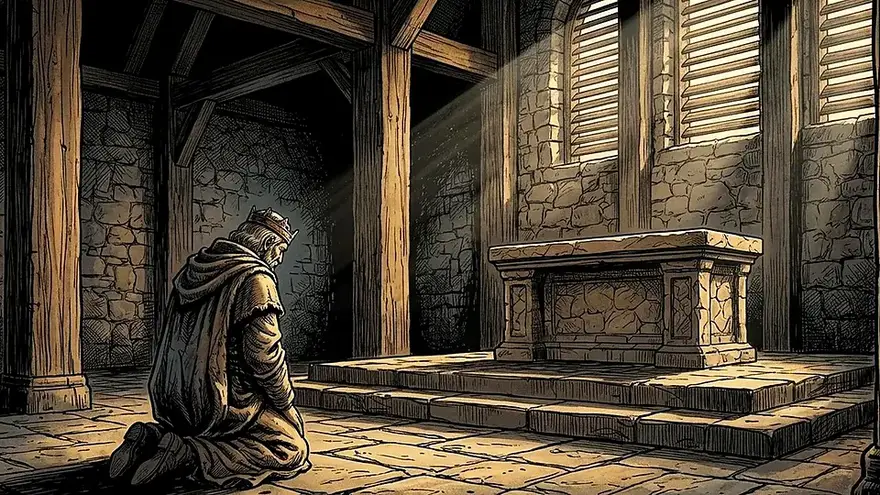
Why the medium screams in terror before performing a single spell
Watch the timing of 1 Samuel 28:11–12 with forensic care. Saul names his request—'Bring up Samuel for me'—and before the narrator records a single pit digging, chant, or smoke trick, 'when the woman saw Samuel, she cried out with a loud voice (watti-z‘aq bĕ-qol gadol)!' Instantly she realizes her tall disguised customer is King Saul himself.
Why would a professional medium shriek in shock when a spirit actually shows up? Because whether her nightly trade relied on shadowy ventriloquism or minor occult impressions, she knew she possessed zero power to yank God's great prophet out of Sheol—yet suddenly Samuel was actually standing there.
1 Samuel 28:12“When the woman saw Samuel, she cried out with a loud voice. And the woman said to Saul, 'Why have you deceived me? You are Saul!'”
'I see ’elohim rising out of the earth!' — Unpacking verses 13–16
Trembling, she answers Saul's 'What do you see?' in verse 13: 'I see ’elohim (אֱלֹהִים) coming up out of the earth!' While English reserves uppercase 'God' for Israel's Creator, Hebrew ’elohim functions more broadly to classify any disembodied inhabitant of the unseen spiritual world—here clarified immediately in verse 14 as 'an old man coming up, wrapped in a robe (mĕ‘il)'—the very prophetic cloak Saul tore in 1 Samuel 15:27!
Notice too how the biblical narrator drops all ambiguity from verse 15 onward, writing flatly five times: 'Then Samuel said to Saul...'—not 'the apparition' or 'the woman pretending to be Samuel.'
1 Samuel 28:13–15“The woman said to Saul, 'I see a godlike spirit (’elohim) coming up out of the earth... An old man is coming up, and he is wrapped in a robe.' ... Then Samuel said to Saul, 'Why have you disturbed me by bringing me up?'”
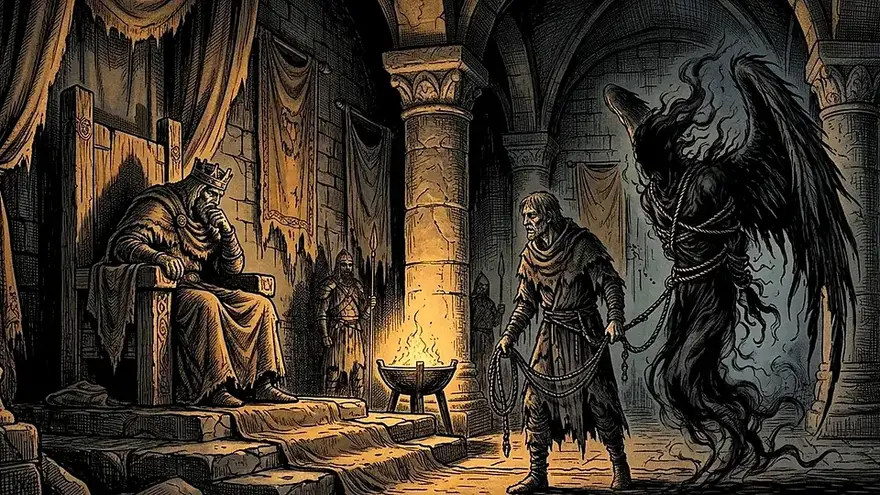
Three classic views: Real Samuel, demonic mimicry, or cold reading?
Across two millennia, thoughtful readers divided into three camps. Early Church Fathers like Tertullian alongside Reformers Martin Luther and John Calvin argued for demonic impersonation—insisting no forbidden séance could disturb a righteous prophet, so a lying spirit wore Samuel's face to crush Saul's morale. A minority proposed psychological cold-reading trickery in a dark room, noting only the woman initially describes him.
Yet Jewish wisdom book Sirach 46:20 ('even after he fell asleep he prophesied'), Josephus, Justin Martyr, Augustine's later reflections, and most modern Hebrew scholars read a real appearance permitted by God—not conjured by Endor's pit—delivering dead-accurate YHWH-centered judgment fulfilled next day on Mount Gilboa (1 Samuel 31; 1 Chronicles 10:13).
1 Samuel 28:19 & 1 Chronicles 10:13“1 Sam 28:19 — 'Tomorrow you and your sons shall be with me.' · 1 Chr 10:13 — 'So Saul died for his breach of faith... and also consulted a medium, seeking guidance.'”
Three Historic Interpretations of 1 Samuel 28
How Jewish and Christian interpreters weighed the evidence of Endor's midnight encounter.
| Interpretation | Key Advocates | Main Textual Evidence | Chief Tension to Explain |
|---|---|---|---|
| 1. Real Samuel Sent by God (Not Her Magic) | Sirach 46:20, Josephus, Justin Martyr, most modern scholars | Medium screams in shock (v.12); narrator calls him 'Samuel' (v.15); prophecy 100% fulfilled next day | Why God made a rare one-time exception to judge Saul |
| 2. Demonic Impersonation | Tertullian, Martin Luther, John Calvin | Deuteronomy 18 bans necromancy; 1 Chr 10:13 condemns Saul for inquiring of an ’ov | Why a demon preaches orthodox Torah obedience & names YHWH seven times |
| 3. Human Ventriloquism / Cold Reading | Reginald Scot (1584), rationalist commentators | Saul relies on the woman's visual description in vv.13–14 while bowed face-down | Doesn't explain her genuine terror before starting or exact next-day death prophecy |
| Ancient Near Eastern Pit Context | Comparative Hittite / Mesopotamian texts | Hebrew ’ov matches Hittite a-a-bi ritual pit for summoning ancestral shades | Highlights how shockingly YHWH overrides Canaanite ritual control |
What to Remember
- Renaissance page headings invented 'Witch of Endor'—Hebrew calls her a ba‘alat-’ov, practitioner of Near Eastern earthen-pit necromancy outlawed in Deuteronomy 18:11.
- Her blood-curdling scream in verse 12 BEFORE performing any incantation signals that Samuel rose by sovereign divine intervention, shattering her usual routine.
- Jewish and Christian interpreters historically divided across three views: real Samuel sent by God (Sirach, Josephus, most modern scholars), demonic impersonation (Luther, Calvin), or cold-reading trickery.