The Bible never calls the northern tribes 'lost.' When Assyria conquered Samaria in 722 BCE (2 Kings 17:6), Emperor Sargon II's Khorsabad palace inscription records deporting 27,290 elite Samarians—under 10% of Northern Israel's population. While exiled elites assimilated in Mesopotamia, most northern Israelites stayed in Galilee/Samaria or fled south into Jerusalem, where Luke 2:36 still meets Anna 'of the tribe of Asher.'
What happened in 722 BCE—and what Sargon II's palace wall actually counts
After King Solomon died around 930 BCE, Israel split into two rival kingdoms: the ten-tribe Northern Kingdom of Israel (capital at Samaria) and the Southern Kingdom of Judah (capital at Jerusalem). Two centuries later, in 722 BCE, the Neo-Assyrian superpower crushed rebel Samaria (2 Kings 17:6).
Did Assyria vacuum everyone off the map? Excavating Assyrian Emperor Sargon II's palace at Khorsabad, archaeologists read his exact cuneiform tally: 'I besieged and conquered Samaria... I counted as spoil 27,290 people who lived in it'—drafting fifty Samarian chariot units directly into his army! Out of Northern Israel's estimated 350,000–400,000 residents, Assyria deported barely 7 percent.
2 Kings 17:6 & Sargon II Khorsabad Annal“2 Kgs 17:6 — 'The king of Assyria captured Samaria, and he carried the Israelites away to Assyria.' · Sargon II — '27,290 people who lived in it I carried away.'”
Why It Matters: The entire medieval map quest to locate the Lost Ten Tribes in a distant country named 'Arzareth' (invoked even by Christopher Columbus's contemporaries!) sprang from a translator misreading two common Hebrew words ('eretz 'acheret, 'another land') in Deuteronomy 29:28 as one proper noun!
Scrolls & Archaeology: Excavated by French consul Paul-Émile Botta at Khorsabad (Dur-Sharrukin) in 1843, Sargon II's cuneiform Display Inscription (lines 23–25) records deporting exactly 27,290 inhabitants from conquered Samaria in 722/720 BCE—leaving behind roughly 90% of rural northern Israelite farmers, many of whom streamed south to swell Hezekiah's Jerusalem to triple its pre-722 size. Meanwhile, Neo-Assyrian cuneiform contracts from Tell Halaf (biblical Gozan, 2 Kings 17:6) record exiled Israelites like 'Palti-Yau' and 'Neri-Yau' working quietly as royal chariot officers and merchants rather than vanishing off the map.
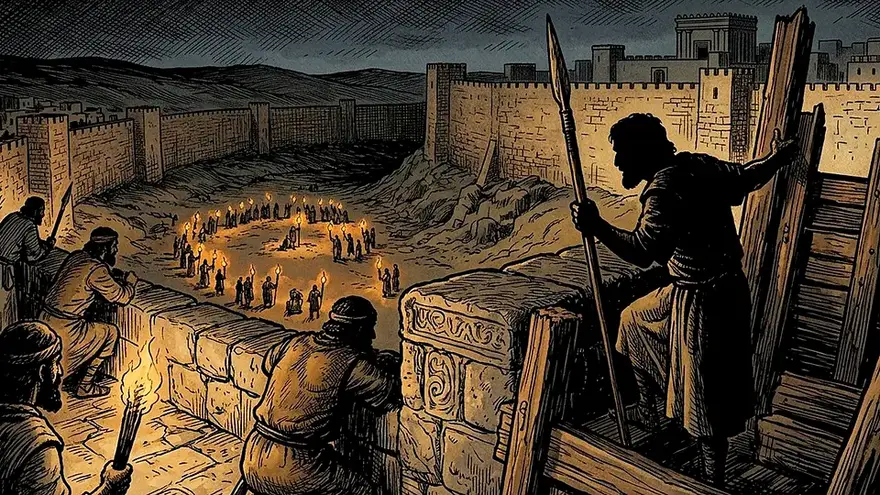
Jerusalem's 23-foot 'Broad Wall' and northern families inside Judah
If those 27,290 aristocratic exiles gradually assimilated in Halah, Gozan, and Media (confirmed by Hebrew Yahwistic names like 'Hoshea' and 'Netanyahu' on 7th-century BCE Assyrian cuneiform contracts along the Habur River), what happened to the other 300,000 northern Israelites?
Tens of thousands of rural farmers stayed right on their ancestral terraced hills in Galilee and Samaria (later intermarrying with foreign colonists settled by Assyria in 2 Kings 17:24), while massive waves of refugees streamed south across the border into Judah! After 1967, archaeologist Nahman Avigad unearthed Hezekiah's 23-foot-thick 'Broad Wall' in Jerusalem's Jewish Quarter—proving Jerusalem's footprint exploded three- to four-fold overnight around 720–701 BCE to house northern Israelite families!
2 Chronicles 30:10–11“So the couriers went from city to city through the country of Ephraim and Manasseh, and as far as Zebulun... However, some men of Asher, of Manasseh, and of Zebulun humbled themselves and came to Jerusalem.”
Why Luke 2:36 meets a woman from 'lost' Asher right inside Jerusalem's Temple
Read the rest of Scripture closely and northern Israelites keep appearing inside Jerusalem in plain sight. In 2 Chronicles 34:9, King Josiah repairs Solomon's Temple using offerings collected 'from Manasseh and Ephraim and from all the remnant of Israel,' while Ezekiel 37 promises one reunited twelve-tribe nation.
Fast-forward seven centuries to the New Testament. When Mary and Joseph carry infant Jesus into Jerusalem's Temple in Luke 2:36, they meet eighty-four-year-old prophetess Anna, daughter of Phanuel, 'of the tribe of Asher'—a northern Galilaean tribe! Likewise Paul tells Agrippa 'our twelve tribes' worship God day and night (Acts 26:7), and James 1:1 greets 'the twelve tribes in the Dispersion.'
Luke 2:36“And there was a prophetess, Anna, the daughter of Phanuel, of the tribe of Asher. She was advanced in years...”

How 'Arzareth' (2 Esdras 13) and the Sambatyon River birthed a global legend
So where did the blockbuster legend of ten hidden tribes marching intact to a secret land come from? Around 100 CE—over 800 years after Samaria fell—an apocalyptic work called 2 Esdras (4 Ezra 13:40–45) misread two ordinary Hebrew words in Deuteronomy 29:28, eretz acheret ('another land'), as a proper geographical country named Arzareth, claiming the ten tribes walked eighteen months past the Euphrates to live untouched until the end times!
Rabbinic folklore later added the roaring Sambatyon River—flinging boulders six days a week and resting every Sabbath so nobody could cross—inspiring centuries of travelers and modern movements to identify everyone from medieval central Asians to Native Americans, Britons, and Pashtuns as the vanished tribes.
Acts 26:7“To which our twelve tribes hope to attain, as they earnestly worship night and day.”
6 Real Digs That Changed How We Read the Bible
Step from 1300 BCE clay tablets to Dead Sea caves and first-century Jerusalem stones.
Hidden in desert jars for 2,000 years, Scroll 4QDeutʲ preserves the oldest reading of Deuteronomy 32:8 ('sons of God'), and 11 Aramaic scrolls of 1 Enoch show why Jude and Peter knew the story of the Watchers.
What Actually Happened to Northern Israel's Population After 722 BCE?
Combining Assyrian royal inscriptions, Israeli archaeology, and Chronicles/Luke replaces the 'vanished into thin air' myth with four documented paths.
| Group | Where They Went | Primary Ancient Evidence | Long-Term Historical Outcome |
|---|---|---|---|
| 1. Deported Royal/Military Elite (~27,290) | Halah, Gozan (Habur River), & Media | 2 Kings 17:6; Sargon II Khorsabad & Nimrud inscriptions | Served in Assyrian army/estates; mostly assimilated or merged into eastern Jewish diaspora |
| 2. Southern Refugees | Jerusalem & Judah's Western Hill | Hezekiah's Broad Wall excavations; 2 Chronicles 30–34 | Absorbed directly into Judah—preserving northern lineages like Anna of Asher (Luke 2:36) |
| 3. Galilean & Highland Farmers | Remained in Galilee & Ephraim/Manasseh | Iron Age II–III settlement surveys; 2 Chr 34:9 | Many reconnected with Jerusalem's Temple or merged with incoming Assyrian populations |
| 4. Samarian Mixed/Continuity Group | Mount Gerizim & heartland Samaria | 2 Kings 17:24–41; Samaritan Pentateuch; genetic studies | Formed the Samaritan community still celebrating Passover on Mount Gerizim today |
What to Remember
- Sargon II's cuneiform annals at Khorsabad boast of deporting exactly 27,290 people from Samaria—only the royal, military, and artisan elite out of roughly 350,000+ northern Israelites.
- Excavations of Hezekiah's 'Broad Wall' in Jerusalem prove Judah's capital tripled in size right after 722 BCE as tens of thousands of northern Israelite refugees poured south.
- The myth of ten tribes marching intact beyond a mystical river comes not from Kings or Chronicles, rather from 1st-century CE apocalyptic lore (2 Esdras 13) and Talmudic folklore.