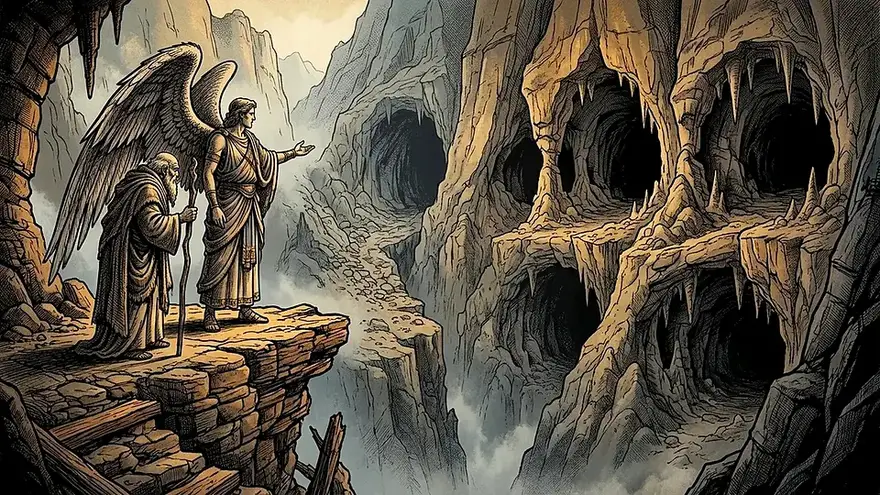
In Deuteronomy 34:5–6, YHWH buries Moses in an unmarked Moabite valley with zero mention of Satan. Third-century scholars Origen, Clement, and Didymus record that Jude 9 cites the lost ending of a first-century Jewish scroll, The Assumption of Moses, where Satan claimed Moses's body (peri tou Mōuseōs sōmatos) over slaying the Egyptian (Exodus 2:12) until Michael quoted Zechariah 3:2: 'The Lord rebuke you!'
Deuteronomy 34's secret Moab grave vs. Jude 9's angelic clash
Read Jude 9 closely: 'When the archangel Michael, contending with the devil, was disputing about the body of Moses (peri tou Mōuseōs sōmatos), he did not presume to pronounce a blasphemous judgment, but said, The Lord rebuke you.' Flip back to Moses's death scene in Deuteronomy 34:5–6 to check what you missed.
In Deuteronomy 34, Moses climbs Mount Nebo overlooking Jericho, dies at age 120, and 'He [the LORD] buried him in the valley in the land of Moab opposite Beth-peor; but no one knows the place of his burial to this day.' Neither Michael nor Satan appears anywhere in Torah!
Jude 1:9 & Deuteronomy 34:5–6“Jude 1:9 — 'When the archangel Michael, contending with the devil, was disputing about the body of Moses... he said, The Lord rebuke you.' · Deuteronomy 34:6 — 'And he buried him in the valley in the land of Moab... no one knows the place of his burial.'”
Why It Matters: To keep transcendent God from touching a corpse directly, the 3rd-century BCE Greek Septuagint changed Deuteronomy 34:6 from 'He buried him' to plural 'they buried him'—giving birth to the Second Temple scroll where Archangel Michael's burial detail confronts the Accuser!
Scrolls & Archaeology: In 1861 at Milan's Ambrosian Library, Monsignor Antonio Ceriani discovered a 6th-century Latin palimpsest (MS C 73 inf.) preserving the first half of the 1st-century Jewish Testament/Assumption of Moses, though its final parchment leaves—right where Moses dies—had vanished! Fortunately, 3rd-century Alexandrian fathers Clement, Origen (De Principiis 3.2.1), and Gelasius of Cyzicus quoted that missing finale explicitly, explaining that Satan tried blocking Moses's honorable burial by indicting him for murdering the Egyptian taskmaster in Exodus 2:12.
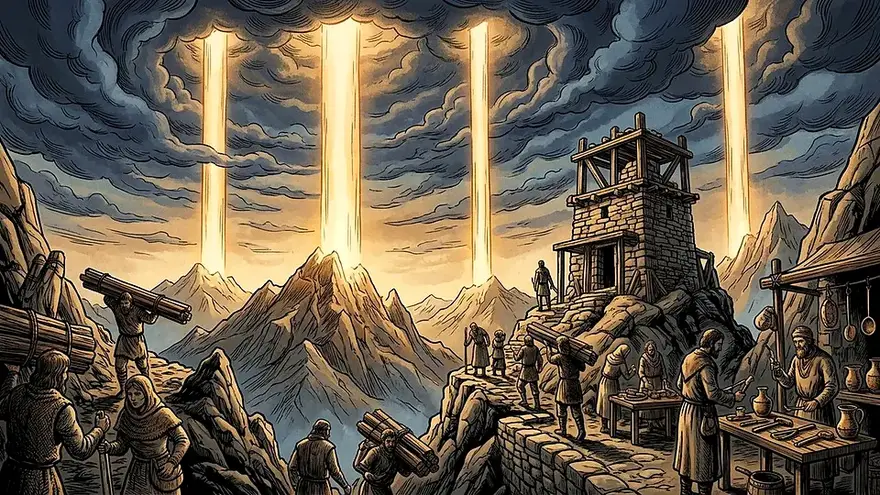
Solved by Origen and Clement: the lost ending of 'The Assumption of Moses'
How did Jude—widely identified as Judas, brother of James and Jesus (Jude 1; Mark 6:3)—expect first-century Jewish-Christian readers to recognize that scene instantly? Three Alexandrian scholars with access to vast ancient libraries—Clement of Alexandria (~200 CE), Origen (De Principiis 3.2.1, ~225 CE), and Didymus the Blind—explicitly wrote down Jude's source: a popular first-century Jewish work titled The Assumption of Moses (Analepsis Mōuseōs).
In 1861, Italian scholar Antonio Ceriani actually discovered a sixth-century Latin palimpsest of The Testament/Assumption of Moses in Milan's Ambrosian Library! Tantalizingly, the surviving parchment tears off at chapter 12 with Joshua weeping at Moses's feet right before Moses dies—leaving early patristic quotations to supply the missing final page.
Daniel 12:1 (Michael as Israel's Guardian Prince)“At that time shall arise Michael, the great prince who has charge of your people.”
Satan's murder indictment from Exodus 2:12—and why God hid the grave
Preserved Greek fragments in Gelasius of Cyzicus, Severus of Antioch, and medieval Catenae scholia reconstruct the clash on Mount Nebo. When God sends Michael—Israel's guardian prince from Daniel 12:1—to bury Moses with honor, the Devil (ha-satan, the prosecutor) steps forward to claim legal custody of the corpse!
Satan presses two charges: claiming lordship over mortal dust, and indicting Moses for murder because forty years earlier Moses 'struck down the Egyptian and hid him in the sand' (Exodus 2:12), arguing a killer forfeited honorable burial—while God hid the tomb lest Israel worship at Moses's shrine.
Exodus 2:11–12“He saw an Egyptian beating a Hebrew, one of his brothers. He looked this way and that, and seeing no one, he struck down the Egyptian and hid him in the sand.”
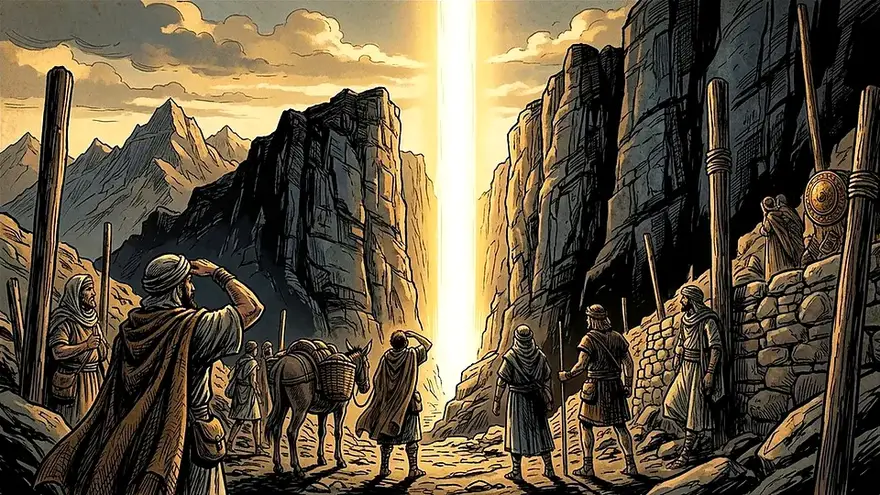
Quoting Zechariah 3:2—why heaven's warrior-angel refused to trash-talk Satan
Watch Michael's reply in Jude 9: instead of trading insults, Michael quotes Zechariah 3:2 word-for-word—'The Lord rebuke you!' (Epitimēsai soi Kyrios). In Zechariah 3:1–4, Satan accuses High Priest Joshua over his filthy garments, and YHWH silences the prosecutor by pardoning grace.
Why does Jude cite this non-canonical story (five verses before quoting 1 Enoch 1:9 in Jude 14)? Citing a familiar Jewish text illustrates a point without canonizing the whole scroll—just as Paul quotes Greek poets in Titus 1:12: if heaven's chief archangel left judgment to God, arrogant teachers dare not scoff at celestial powers (Jude 8).
Zechariah 3:1–2“Then he showed me Joshua the high priest standing before the angel of the LORD, and Satan standing at his right hand to accuse him. And the LORD said to Satan, 'The LORD rebuke you, O Satan! The LORD who has chosen Jerusalem rebuke you!'”
Tracing the Moses Burial Tradition Across Four Ancient Texts
How Torah, post-exilic prophecy, Second Temple scrolls, and Jude 9 intersect.
| Text | Era | What Happens | Key Role in the Puzzle |
|---|---|---|---|
| Deuteronomy 34:5–6 | Torah | YHWH buries Moses in Moab; grave stays unknown | Leaves room for Second Temple questions about how God buried him |
| Zechariah 3:1–2 | ~520 BCE | Accuser indicts High Priest Joshua; 'The LORD rebuke you!' | Supplies the exact courtroom rebuke Michael speaks in Jude 9 |
| Assumption of Moses | 1st c. CE | Satan cites Exod 2:12 murder to claim Moses's corpse vs. Michael | Identified by Origen & Clement as Jude 9's direct narrative source |
| Jude 1:8–10 | ~60s–80s CE | Michael refuses abusive speech, deferring judgment to God | Rebukes arrogant false teachers who scoff at heavenly powers |
What to Remember
- Jude 9 contains the sole occurrence of the word 'archangel' (archangelos) connected to a personal name—Michael—anywhere in the 66-book Protestant canon (compare 1 Thessalonians 4:16).
- Early Church Fathers preserved the lost finale of The Assumption of Moses, explaining that the Devil indicted Moses for slaying the Egyptian in Exodus 2:12 to block his honorable burial.
- Just as Jude quotes 1 Enoch 1:9 five verses later (Jude 14), citing a familiar Second Temple story illustrates a moral point without adding the entire outside scroll to the biblical canon.